The High Court is listening. Are we?
The under‑16 social media ban challenge, explained for families
On 3 and 4 November 2026, all seven justices of the High Court heard the first major legal challenge to Australia’s under‑16 social media ban. The question before the court is whether the law places an unfair burden on young people’s ability to take part in public conversation.
Ban still in place. Decision reserved.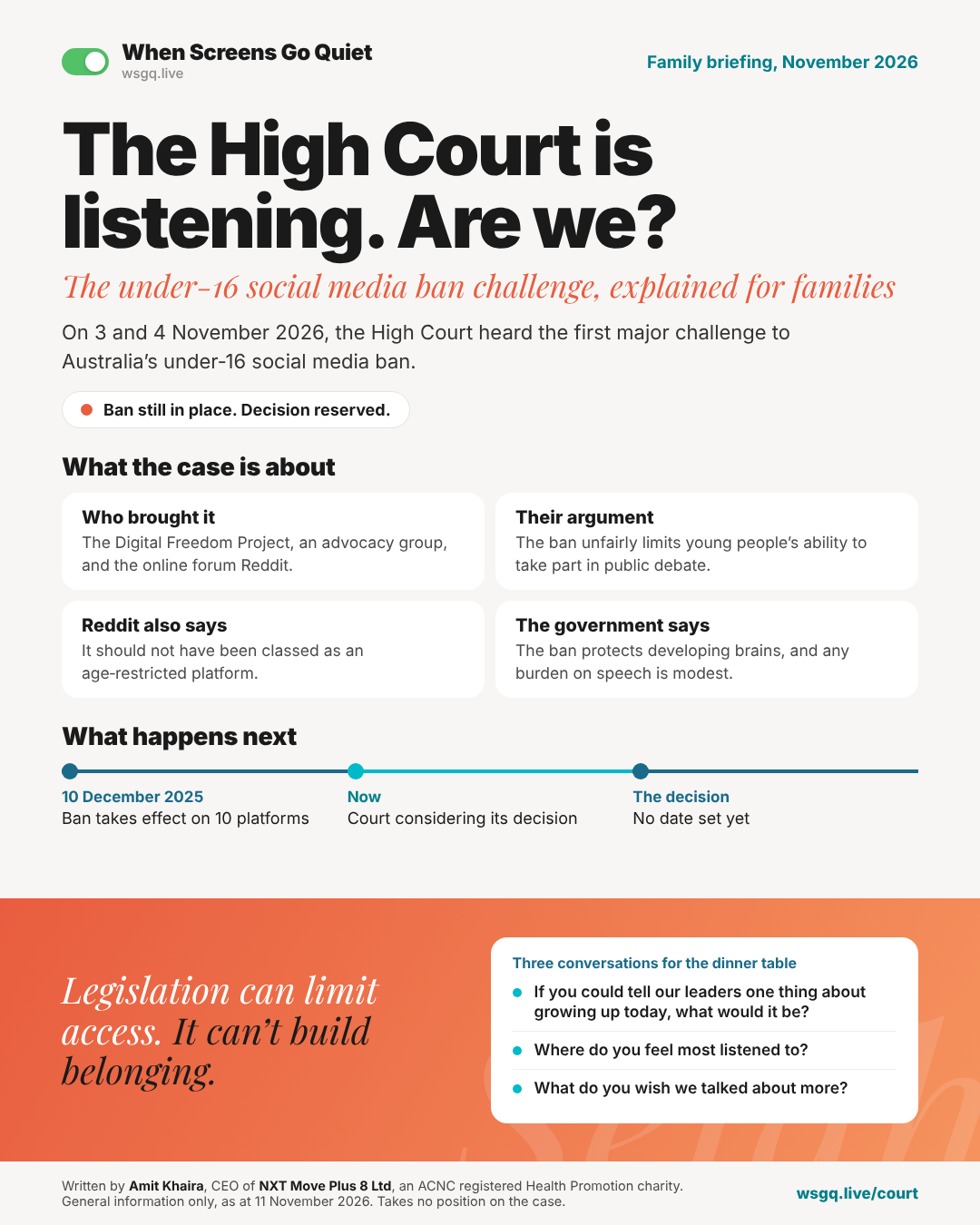
What the case is about
Who brought it
Two challenges are being heard together: one from the Digital Freedom Project, a Sydney-based advocacy group, and one from the online forum Reddit.
The main argument
The challengers say the ban unfairly burdens the freedom of political communication implied in the Constitution, by limiting young people’s ability to be part of public debate.
Reddit’s extra argument
Reddit also says it should not have been classed as an age-restricted social media platform under the law.
The government’s response
Government lawyers argued the ban is needed to protect young people’s developing brains, and that any burden on political communication is modest and indirect.
What happens next
The ban takes effect across 10 major platforms
The hearing has finished and the court is considering its decision. The ban remains in place.
The court will rule on whether the law, or parts of it, can stand. No date has been set.
Whatever the court decides
“Is the ban legal?” matters. But the question we hear most from parents is “What now?”
The challengers make a fair point: young people’s voices matter, and they deserve to be heard. Here are three ways families can make sure that happens close to home.
Make room to listen
The best conversations rarely get scheduled. They happen in car rides home, on the sidelines of a Saturday game and while the dishes get done.
Talk with them, not just about them
Ask what they think of the ban and the court case. You may be surprised by how much they have already thought it through.
Widen the circle
Teachers, coaches, chaplains, youth leaders and neighbours all help a young person feel seen. No family has to do this alone.